Coming soon · Stigmatica launches with a 14-day free trial
STIGMATICA
Optical design software

Tell it what you need.
Get a lens that works.

Give Stigmatica a focal length, an F-number and a field of view. It builds the lens for you, checks every ray, and hands you files you can open in Zemax, CODE V or QUADOA. Usually in minutes.
Join the waitlist See real designs
No internet No tokens No NDA 100 % private
Windows · macOS · Linux — everything runs on your own computer
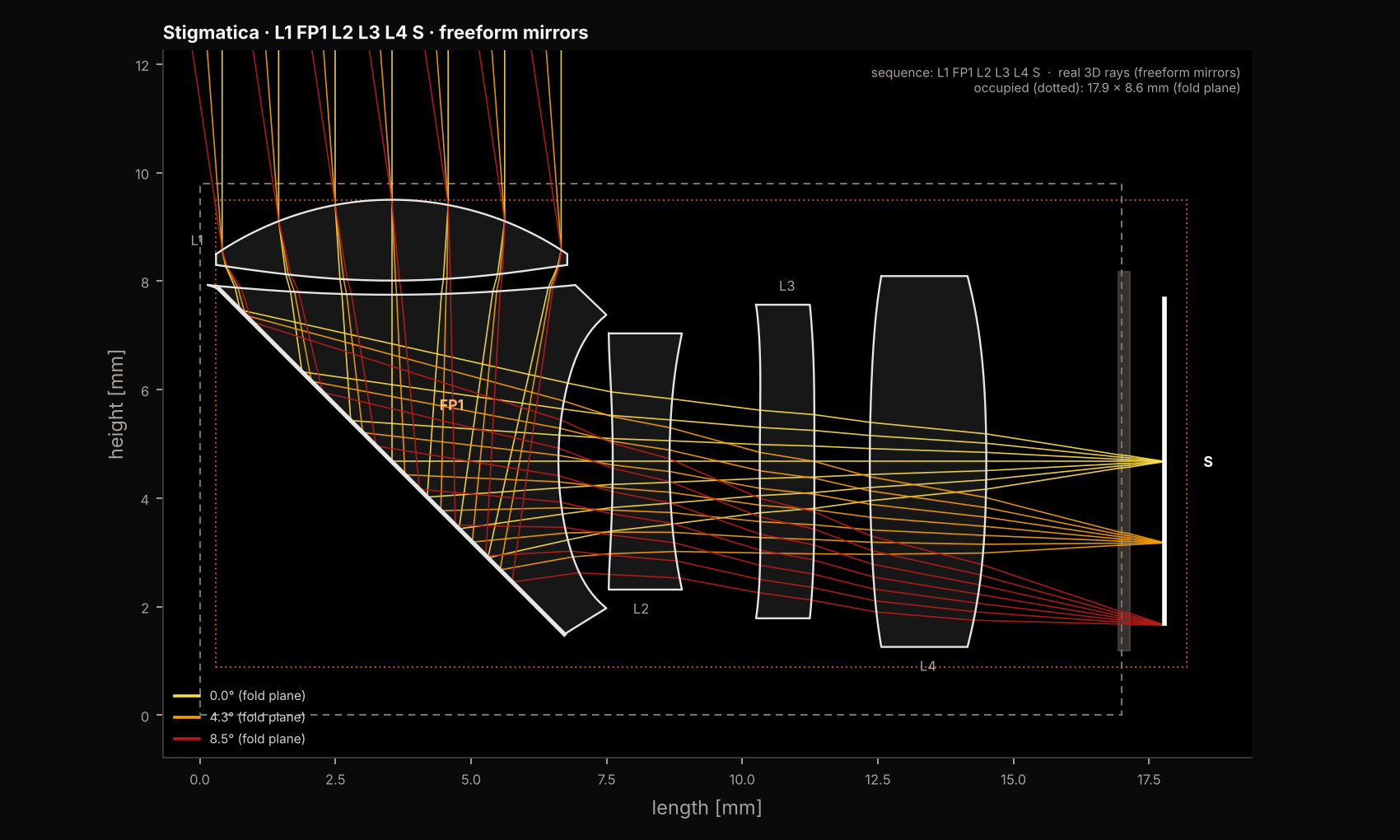
Folded camera lens with a freeform prism, designed by Stigmatica, with real rays traced to the sensor
A folded camera with a freeform prism and four lenses. Designed by Stigmatica, rays are real.
0.28 µm
worst spot (RMS) in the freeform prism camera, at 555 nm
7 lenses
phone camera, F/2.4, 64° field, designed from scratch
.zmx · .seq
exports that open straight in Zemax, CODE V and QUADOA
5 languages
user manual in English, Spanish, German, Chinese and Japanese
Private by design

Your lens never leaves your computer

Unreleased optics are some of the most sensitive data a company has. Stigmatica keeps all of it on your machine. Nothing is uploaded, nothing is metered, and nobody else ever sees your design.

No internet connection

Works fully offline, even on an air-gapped computer. No sign-in, no cloud, no telemetry. Your licence is a small file.

No tokens, no credits

No per-design fees and no usage meter. Run a hundred designs overnight if you like; it costs the same as running one.

No NDA needed

Your specifications and designs are never shared with us or anyone else, so there is nothing to sign before you start.

How it works

Most lens design starts from an old patent and a lot of trial and error. Stigmatica starts from the physics instead, so the first design is already close to the answer.

01 · Describe

Your specs, in plain numbers

Focal length, F-number, field, sensor, track length, how many lenses, glass or plastic, the space you have. Fill a form or load a ready-made example.

02 · Design

Physics first, then polish

The aspheres are computed order by order with an optical path aberration expansion. Real ray tracing then polishes the design over the whole field, and the last surface is made exactly stigmatic.

03 · Check and export

Analyse, then take it anywhere

Spots, PSF, MTF, distortion, colour, field curvature and more. Export to Zemax, CODE V and QUADOA, plus a plain-text prescription.

What you can design

From a simple triplet to a folded phone camera with freeform optics.

Camera and imaging lenses

Phone lenses with 3 to 7 plastic elements, glass triplets, telephotos. Even aspheres up to r¹⁶.

Folded optics

Periscopes, pentaprisms, Porro, Amici and other prisms. Give it a box and it finds a layout that fits.

Freeform mirrors and prisms

Tilted freeform surfaces traced in full 3D, exported as XY polynomials.

Microscope objectives and finite conjugates

Set the magnification and the object-side NA; the object distance is part of the design.

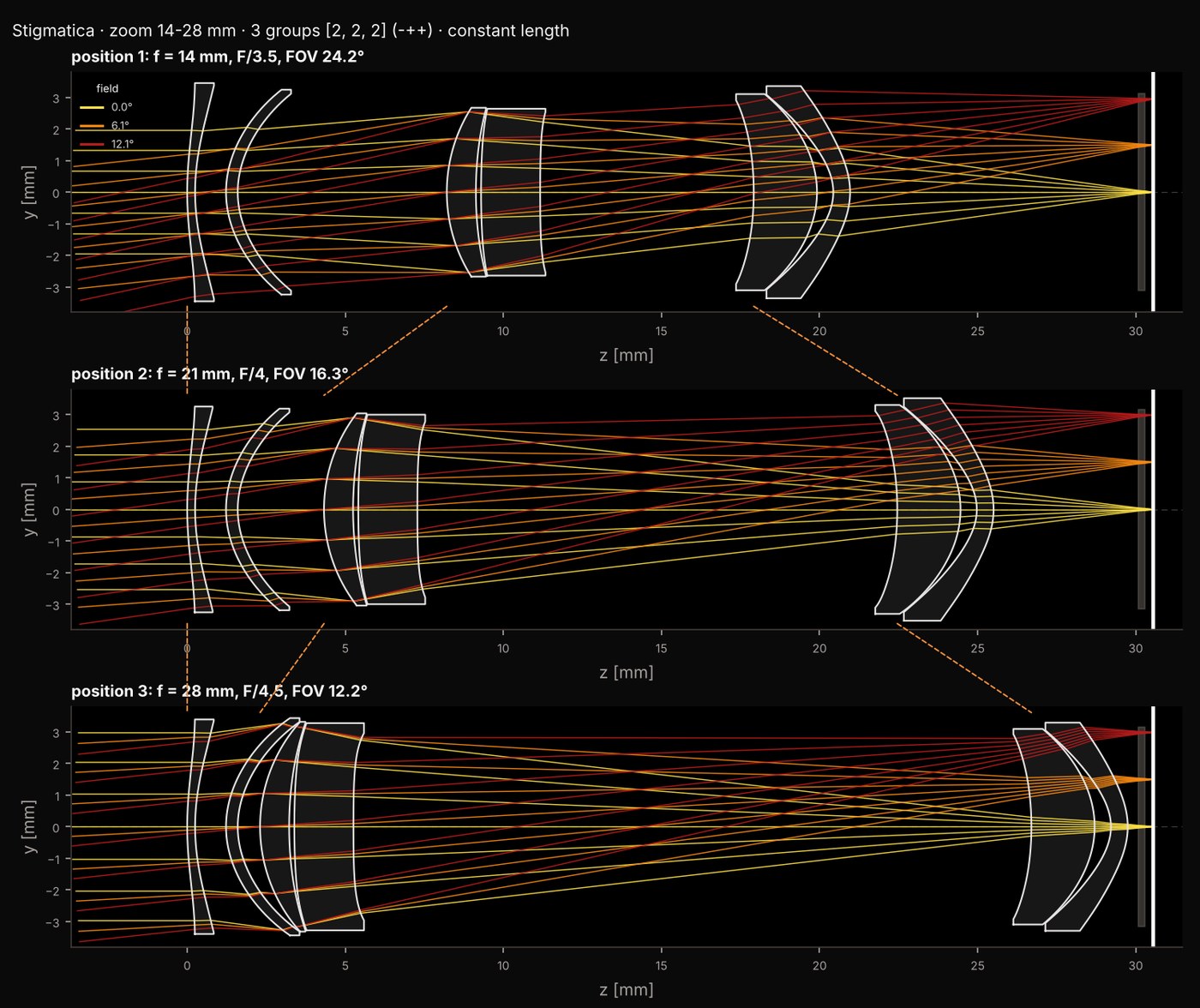
Zoom lenses

Several zoom positions designed together, with the moving groups and a cam table.

Colour and glass choice

Built-in glass and plastic catalogues, your own .agf catalogues, and automatic glass selection over the band.

Telescopes

Newtonian, Cassegrain, Ritchey–Chrétien, Gregorian, Schmidt, Schmidt–Cassegrain, Maksutov, refractors and three-mirror anastigmats like Hubble and JWST, plus a stigmatic Cassegrain whose secondary is computed exactly, ray by ray.

Vector PSF and polarization

Every ray carries its polarization through every surface, with Fresnel transmission. The full field at focus, |Ex|², |Ey|² and |Ez|², comes from a general diffraction integral for converging freeform vector fields.

Spectacle lenses

Single-vision lenses traced through the centre of rotation of the eye: power error and oblique astigmatism at every gaze angle, and a flatter, thinner aspheric design.

Stigmatic singlets

One lens, perfect on axis at any aperture: the second surface is computed exactly, in closed form. For collimators, condensers and laser focusing.

Real designs, real numbers

Designs made with Stigmatica, from phone cameras to telescopes. The phone camera, freeform prism and microscope were also checked by an independent ray tracer reading the exported files.

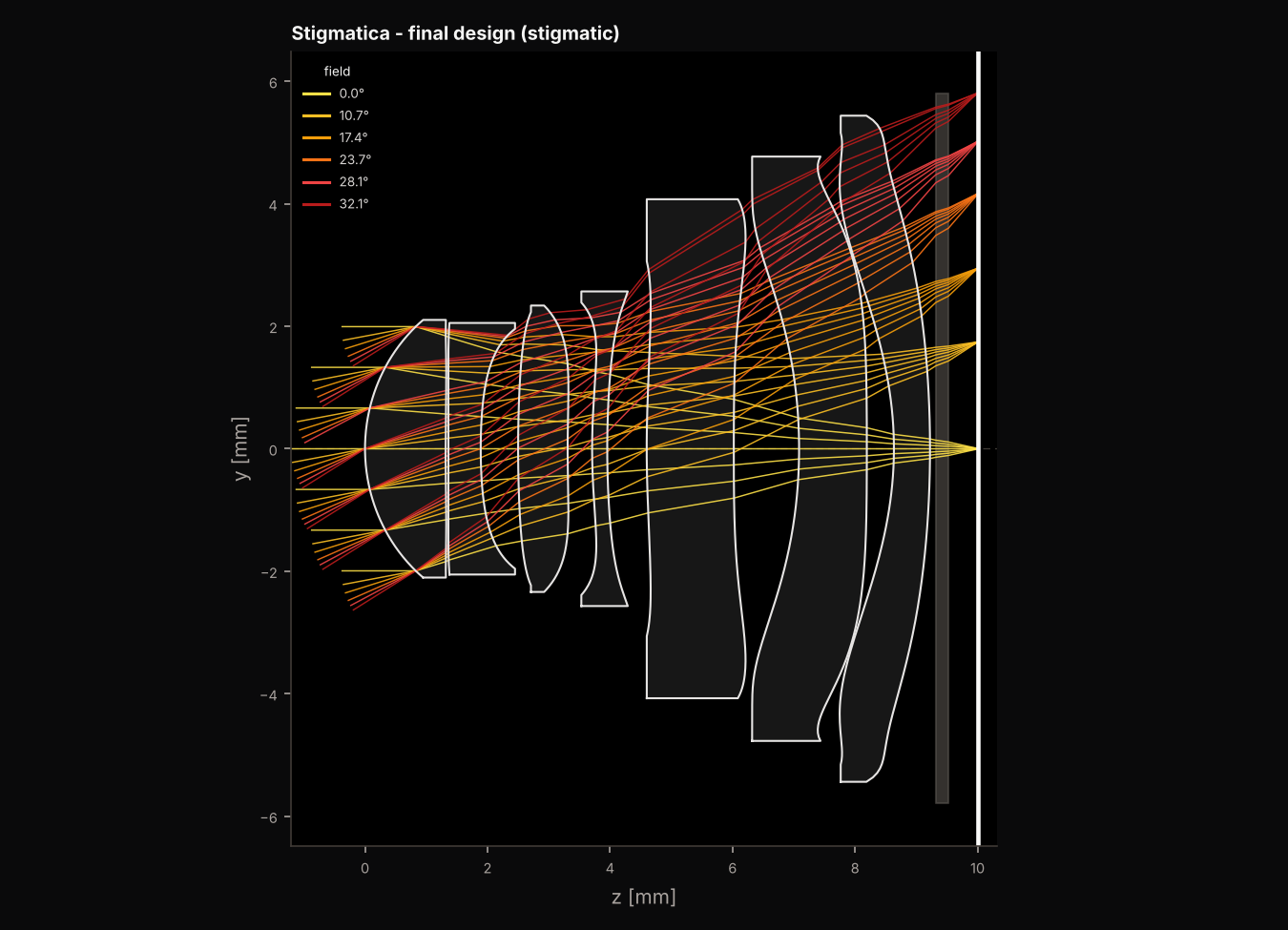
Seven-element plastic phone camera lens with rays at six field angles

Phone camera, 7 lenses

f 9.57 mm · F/2.4 · 64° · 7 plastic elements

Worst spot 3.4 µm across the full field, distortion within ±3.2 %. About 20 minutes on a laptop.

Folded camera with a freeform prism

Freeform prism camera

f 20 mm · F/3.2 · 28° · 4 lenses + freeform prism

Worst spot 0.28 µm, Strehl ratio 0.97 to 0.99 over the field. Diffraction-limited.

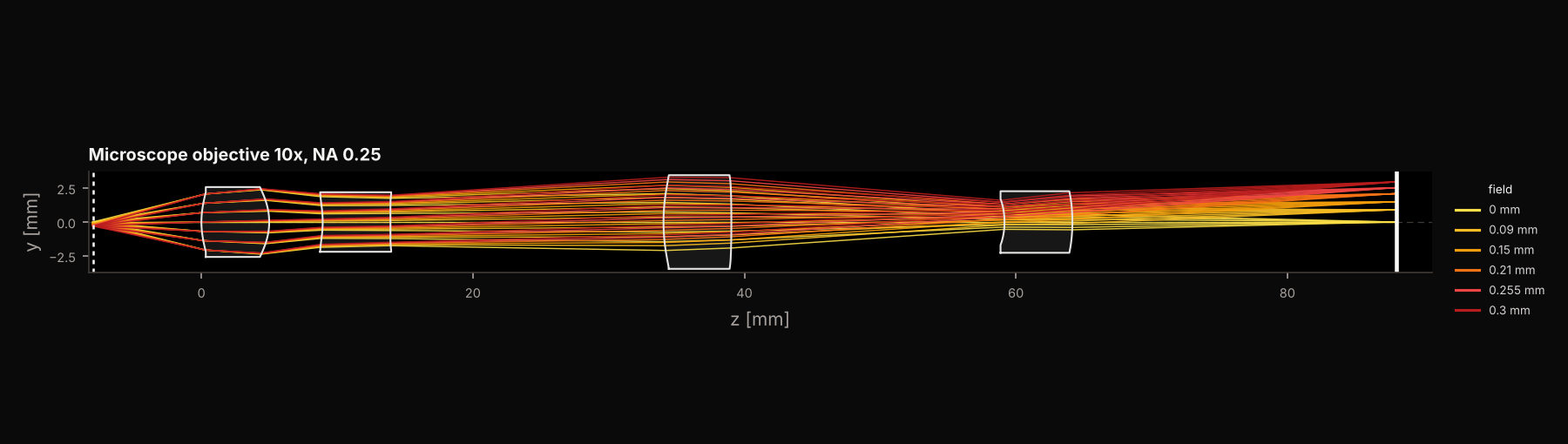
Four-lens 10x microscope objective

Microscope objective 10×

NA 0.25 · finite conjugate · 4 lenses

Strehl ratio 0.95 to 0.99 across the field at 555 nm. About 8 minutes.

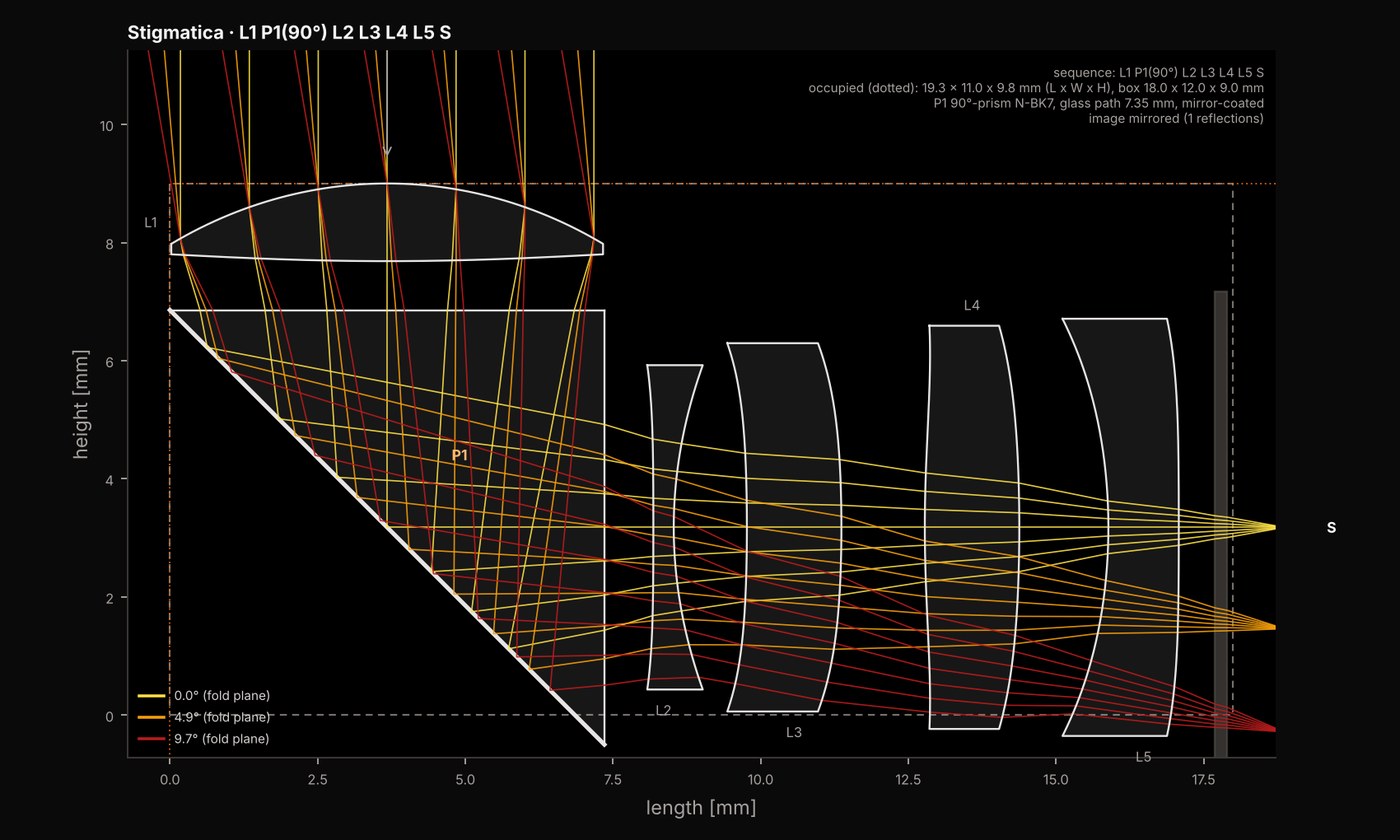
Periscope camera: a lens, a 90-degree prism and four lenses, with real rays folded onto the sensor

Periscope camera, prism + 5 lenses

f 20 mm · F/2.86 · 31.8° · 90° prism + 5 lenses

Polychromatic Strehl ratio 0.95 to 0.99 from 470 to 650 nm, worst spot 0.56 µm. Diffraction-limited across the whole band.

Six-lens zoom shown at 14, 21 and 28 mm

Zoom lens 14–28 mm

2× zoom · F/3.5–4.5 · 6 lenses in 3 groups

Three zoom positions designed together, with shared lenses and constant length. Strehl ratio 0.78 to 0.99 at 555 nm in every position.

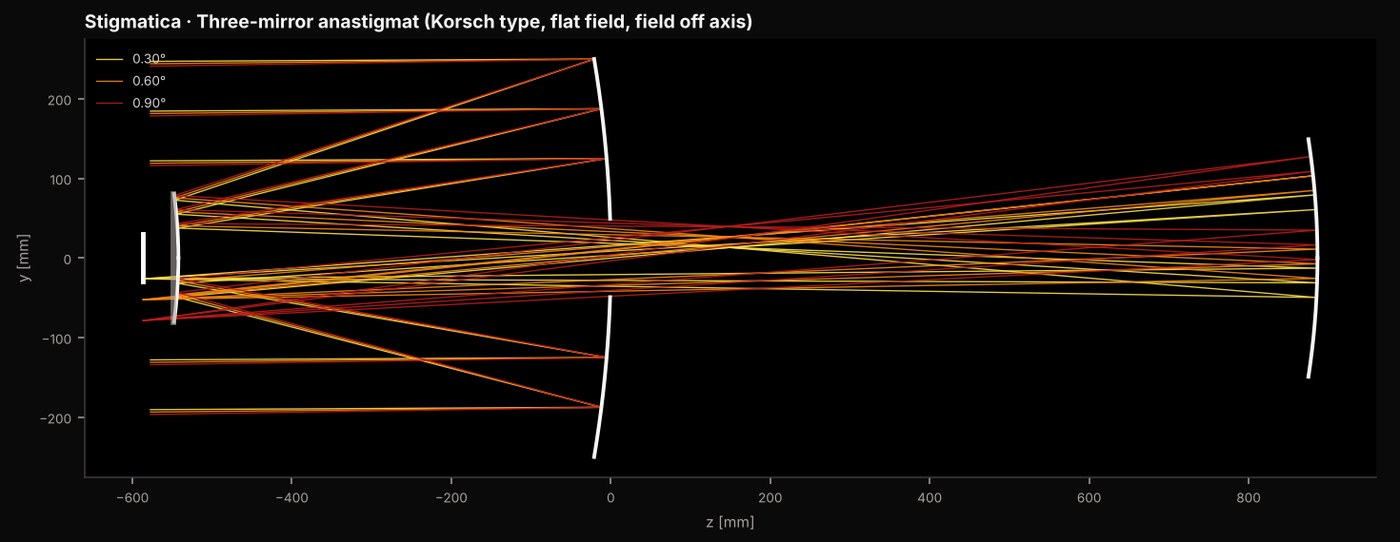
Three-mirror anastigmat telescope with an off-axis field

Three-mirror anastigmat

500 mm · F/10 · 0.3° to 0.9° field · 3 mirrors

Strehl ratio 0.988 to 0.999 over the whole field, on a flat image. Diffraction-limited.

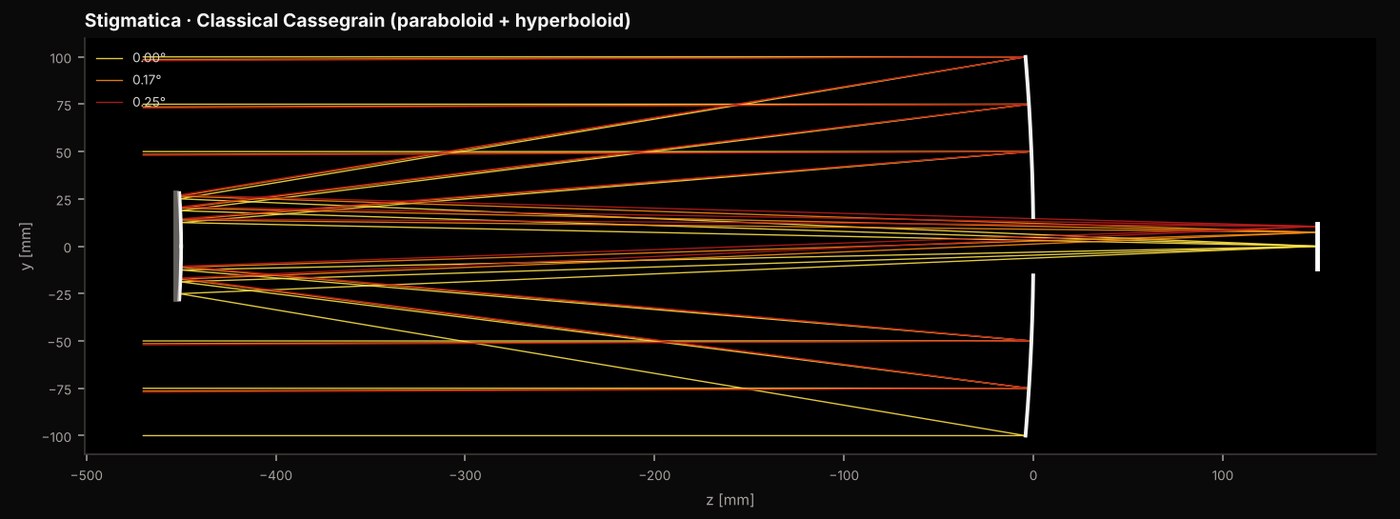
Classical Cassegrain telescope with a paraboloid primary and a hyperboloid secondary

Classical Cassegrain

200 mm · F/12 · paraboloid + hyperboloid

Perfect on axis (Strehl ratio 1.00) and 0.92 at 0.125°. Beyond that, the coma that theory predicts for this form.

Vector optics

Polarization and the vector PSF

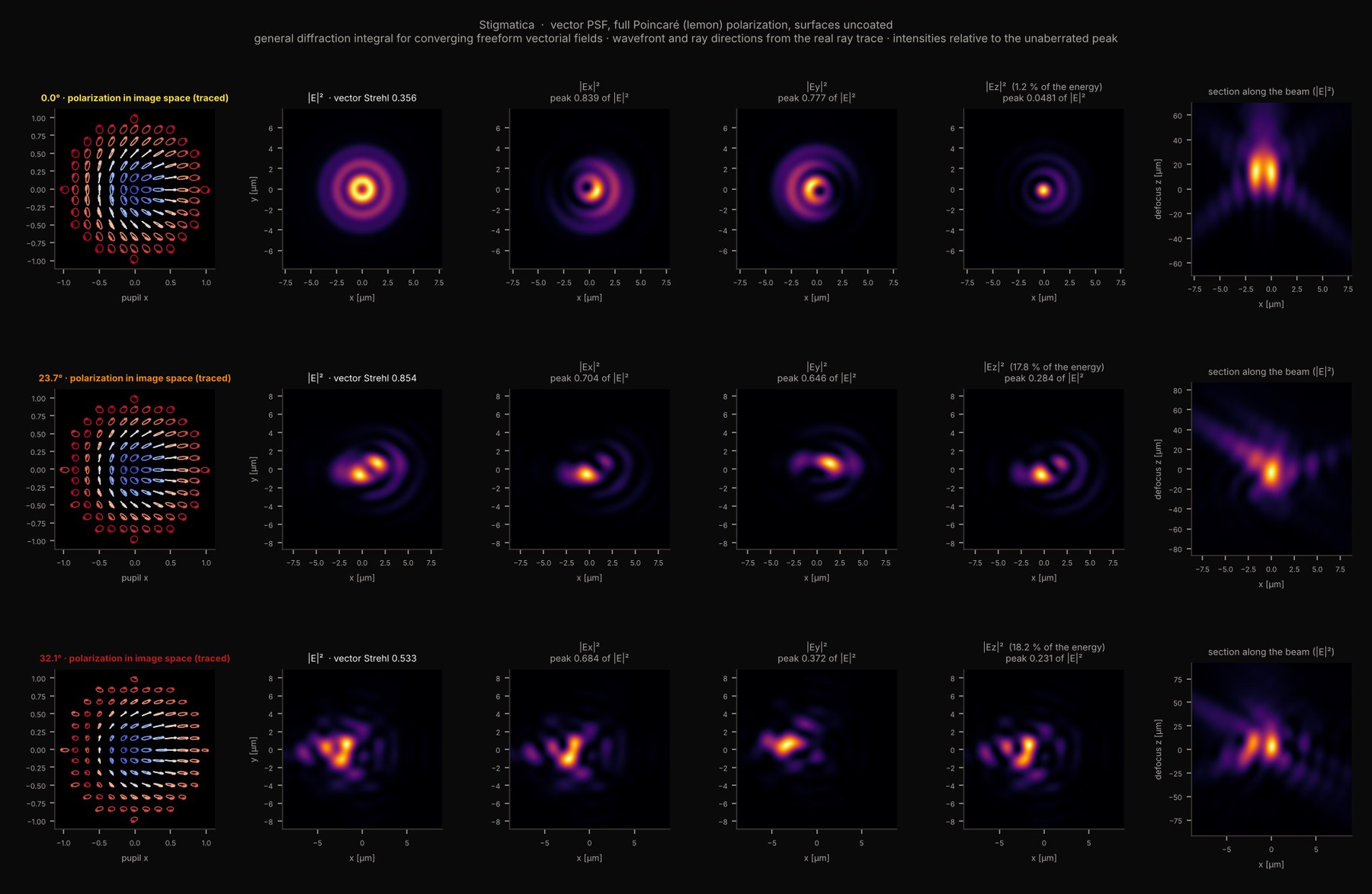
Stigmatica traces the polarization of every ray through the real lens, then computes the point spread function with a general diffraction integral for converging freeform vector fields. No scalar shortcut: you see the transverse and the longitudinal field at focus.
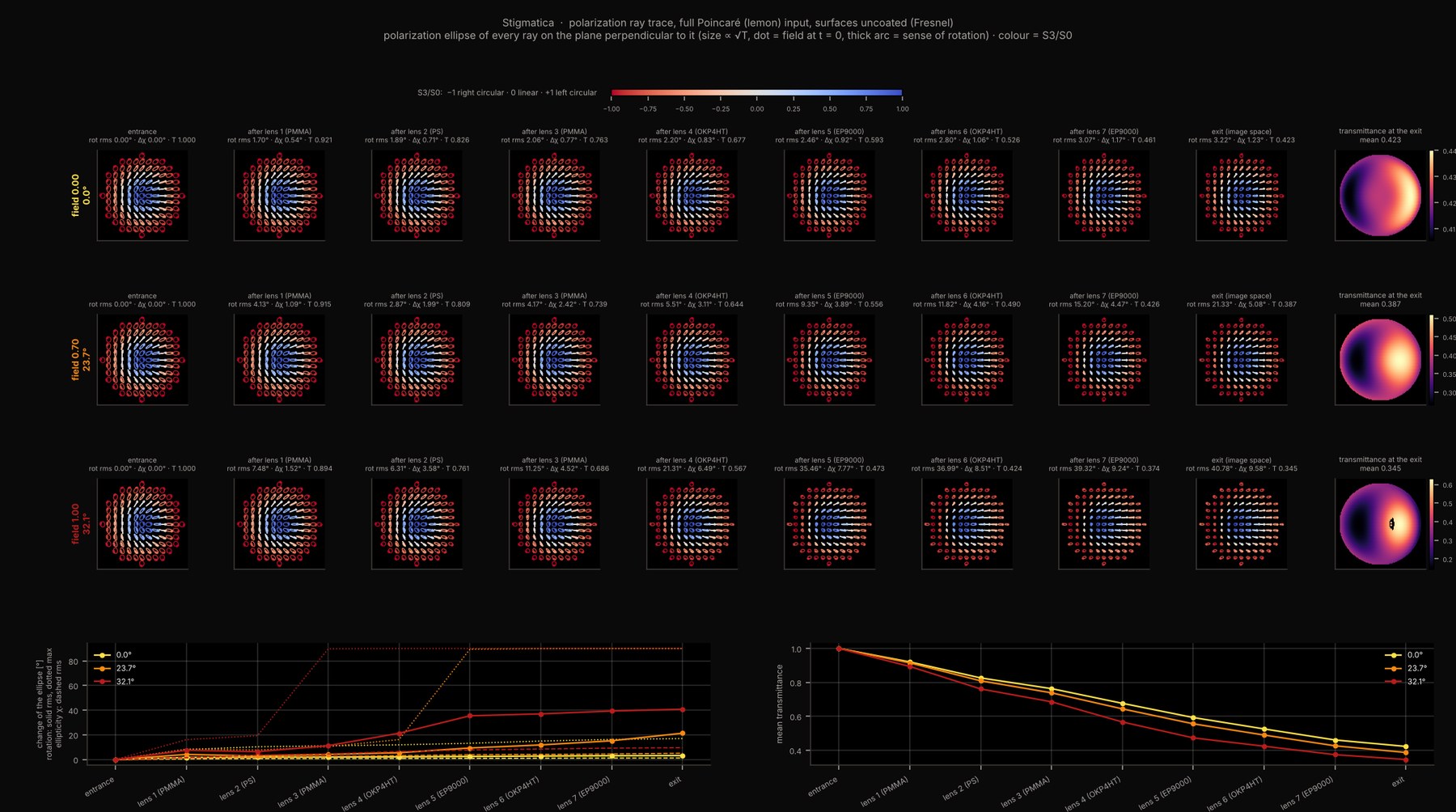
Polarization ray tracing
s and p Fresnel transmission at every refracting surface, uncoated or with an ideal anti-reflection coating. The field turns with each ray.
Any input state
Linear at any angle, radial, azimuthal, spiral, left or right circular, elliptical, and full Poincaré beams.
Lens by lens
Polarization ellipses, rotation, ellipticity and transmittance after every element, for every field.
Vector PSF and vector Strehl
|Ex|², |Ey|² and |Ez|² on the image plane and along the beam, from the traced fields of the real design.
Polarization ellipses of a full Poincaré beam after every lens of a seven-lens phone camera, at three field angles
A full Poincaré beam through a seven-lens phone camera: the polarization ellipse of every ray after each lens, and the transmittance at the exit.
Vector PSF of the same beam: total intensity and the x, y and z field components at three field angles
Its vector PSF at three field angles: |E|², |Ex|², |Ey|², |Ez|² and a section along the beam.

Friendly from the first click

You don't need to be a lens design expert to get started. Pick an example, press Design and watch the lens take shape.
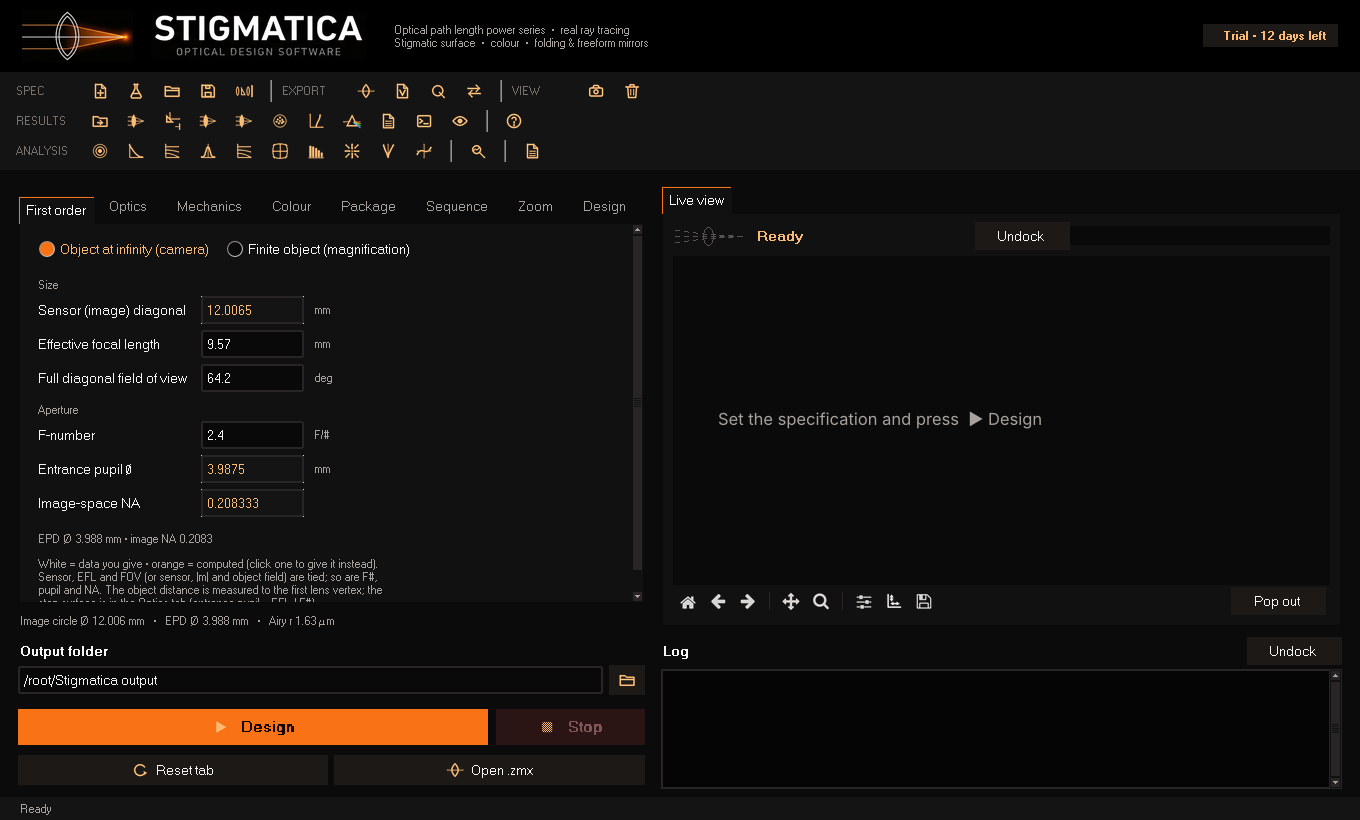
  • Live view of the layout, spots and colour while it optimizes
  • Interactive plots: zoom, hide fields, set your own axis ranges
  • Plain-language warnings that tell you what to change
  • A 30-page manual with worked examples
The Stigmatica interface with the specification form and the live view
The science behind it

The power of stigmatic surfaces

A stigmatic surface sends every ray from one point to exactly one point: perfect imaging, for every ray and every aperture, not just near the axis. Most software can only get close to this by trial and error. Stigmatica writes the surface down exactly, in closed form.

That changes how a design starts. Instead of searching blindly, the program begins from a lens that is already perfect at its reference point. The optimizer then only has to share that quality across the field. It is faster, more predictable and reaches designs that random searches tend to miss.

The equations inside Stigmatica are exact, published in peer-reviewed journals and tested on real designs.

Optical path aberration expansion
Aspheres computed order by order, so the starting design is already good.
Exact stigmatic surfaces
A closed-form last surface that brings every ray to a perfect point. No series truncation, no approximation at high aperture.
Works for any surface before it
Spheres, aspheres or freeforms in front, glass or plastic: the stigmatic surface is computed for the actual rays that reach it.
Real ray tracing
Every result is checked with real rays, in 3D for folded and freeform systems.

Simple pricing

One yearly licence with every feature. A 14-day free trial is coming soon.

Stigmatica licence

$500USD / year

For engineers, companies, universities and research groups.

  • Every feature, commercial use included
  • One computer, works offline
  • Updates and support for the year
  • 14-day free trial (coming soon)
Trial coming soon

Team

Let's talk

Several seats, site licences or custom features.

  • Volume pricing
  • Training on request
  • Direct line to the developer
Contact coming soon

Questions

Do I need an internet connection or an account?

No. Stigmatica runs entirely on your computer. Your designs never leave it.

What happens when the trial ends?

You can still open and look at every design you made. To design and export again, load a licence file. You get it by sending us the machine ID shown in the program.

Can I keep working in Zemax or CODE V?

Yes. Stigmatica writes .zmx files for Zemax OpticStudio and QUADOA and .seq files for CODE V, so you can tolerance and finish the design in the tools you already use.

Can it import my existing designs?

Not yet. Stigmatica designs from your specifications. Importing .zmx files is on the roadmap.

Which computers does it run on?

Windows, macOS and Linux. A normal laptop is enough: most designs take minutes, the hardest ones an hour or two.

Free trial coming soon

Stigmatica for Windows, macOS and Linux is almost ready. The 14-day trial, with every feature, opens soon. Leave your email and you will be the first to know.

Coming soon
Join the waitlist and we will write once, when the trial opens. Your email is used for nothing else.